BIRD WATCHING
Basic Bird Identification
|
 |
Name that bird.
Andrew Cooper’s short cuts to success.
Top Tips
You are far more likely to see a common bird than a rare one. So start your identification assuming it is a common species rather than a really scarce one.
Get to know the birds you see most often and learn to identify adults and young. Even experts can get it wrong so learn from your own and other people’s mistakes! |
PLUMAGE
- What colour?
Be as accurate as possible.
CONCENTRATE ON KEY AREAS:
HEAD – is it all one colour or are there extra markings – a cap, hood or stripe through or above the eye?
WINGS – plain coloured, bars, spots or panels of colour?
RUMP AND BACK - is the rump a different colour?
UNDERPARTS – is the breast and belly plain or spotted, streaked or barred? Is it all the same colour or is there a difference between sides and breast.
Legs
- what colour? |
 |
 |
SIZE,
SHAPE and SOUND
Compare the bird size
with one you already know - a sparrow or crow.
Make
a note of its shape
– plump or sleek, long wings or short?
Does
it have a feather crest on its head?
What
about legs –
long or short, and length relative to neck and tail?
Beak
size and shape can tell you a lot about a bird's life style.
Learn
to recognise calls. Useful apps are now
available for smart phones.
|
BEHAVIOUR
Different birds behave in different ways – usually! Most ducks behave like ducks and warblers behave like their close kin. So even if you cannot accurately identify a bird, at least you can hazard a guess to its group.
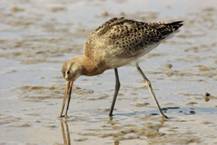
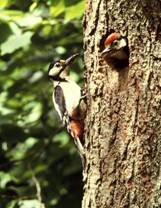
Swallows, swifts and martins spend most of there life in the air, while woodpeckers, tree creepers and nuthatches literally hang around trees! Flycatchers will dart up from a perch to grab a passing insect, while wading birds seem to spend most of their lives probing mud with their long beak.
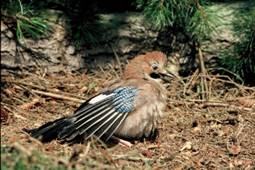
Some birds occasionally behave in a very odd way, like a jay anting – bathing in a shower of formic acid as wood ants defend their nest. |
 |
LOCATION, LOCATION, LOCATION!
The place a bird usually lives is very important - its habitat. But this can change at different times of the year. In winter the curlew may be seen on an estuary or around the coast, while in summer they bred on moorland.
Some birds are very precise in their habitat. The crossbill feeds mainly on conifer cones, so is seldom ever found far from these trees.
Other
birds may travel much further, these are migratory species
and the time of year will help to identify a bird. In Britain
you are unlikely to see a swallow at Christmas or a Waxwing
in midsummer. |
| |